Thursday, June 14, 2012

Craft beer economies of scale

Ripped content from
http://craftbeerrestaurant.com/blog/?page_id=428

In the restaurant setting, craft beer pricing has much more in common with wine pricing than it does with macro-brew beer pricing. So look to your established wine-pricing formulas when establishing your guidelines for craft beer pricing.

Bottled Beer

For many better restaurants, the majority of craft beer sales will be by-the-bottle. For some restaurants, beer list pricing can mean simply taking the wholesale cost per bottle and multiplying by 2.0 or 2.5 or 3.0 (often 2.0 for higher priced products and more for lower priced beers). Don’t worry too much about odd pricing numbers. Just round each up to the next nickel or dime, like $4.32 up to $4.35 or $6.36 up to $6.40. Craft beer customers expect quite a bit of variance from type to type and brand to brand.

An alternative pricing strategy is multiplying the wholesale cost of each beer by a fixed mark-up factor, say 2.0, then adding on a fixed overhead service charge of something like a fifty-cents or a dollar per bottle, and then rounding up to the five or dime.

Examples:

A 12-oz bottle of craft beer with a wholesale cost of $1.67 is fairly sold for up to $4.25 or so.

A 22-oz bottle of craft beer with a wholesale cost of $4.50 is commonly be sold for $9.00 – $12.00.

A 750-ml bottle of craft beer with a wholesale cost of $8.00 could be priced up to $17.00 on a beer list.

If your restaurant still sells bottled versions of Bud-Miller-Coors macrobrews, there is no need to change your existing pricing formulas for them. Some restaurants set a minimum selling price for even the cheapest beer and price beer there even if their normal mark-up formula would have the beer selling for less.

Variations from market to market do exist as to what is customary for craft beer mark ups. Some locations have much higher overhead (rent, labor, taxes, etc.) than others, so beer pricing will justifiably vary from area to area. Price yours fairly for your market and you will make your customers happy.

Draught Beer

The cost-per-ounce for craft beer in kegs is roughly 40-45% less than the same beer in bottles. You can see how selling craft beer on draught is a good profit opportunity if handled properly and efficiently. The general pricing strategy for draught beer is similar to those described above for bottled beer, but a higher mark-up rate is customarily utilized.

Since the overhead cost for draught beer is higher — draught system equipment depreciation cost, system maintenance/supplies (CO2, nitrogen, adjustments, weekly line cleaning, keg change-outs, etc.), spillage, and potential spoilage — it is customary to factor in a higher overhead charge-per-glass than would be charged for bottled beers. In practice this should bring the regular sale price-per-ounce to roughly the same point as the bottled version of the same beer. This higher regular price also allows room for periodic special pricing on draught beer, such as during early evening hours when business is typically slower.

Rule of Thumb

If most of your craft beer business is by-the-bottle, calculate your selling price for the bottles and then price your draught beer similarly (ounce for ounce, similar product category). Conversely, if your craft beer business is predominantly done on tap, determine your draught beer sales prices and price bottled beers comparably. That means that two beers of similar quality, type and style should sell for a similar price-per-ounce even though one is bottled and one is draught.

Price variety important

Having price variety among the craft beers on the beer list is a good thing. Craft beer customers, like fine wine customers, understand that product costs vary greatly. They expect each product offering to be priced based on its underlying cost. When offering two beers in the same style category, it works best to have one of them a more exclusive brew at a higher cost than the other to encourage a trade up to higher perceived quality (and higher restaurant profit).

As with wines, the price of a craft beer is a proxy for its quality. The higher the price, the greater the perceived quality. It is a good practice to offer at least a couple of beers that cost 50% to 100% more per bottle than the standard craft beer offerings. Similar to offering a grand cru Bordeaux, a 98-point-rated Cabernet Sauvignon, a Barolo or high-end Champagne, offering one or more of the world’s very best beers sets a premium tone for the entire beer list.

For example, the Belgian Trappist beer Orval, widely considered among the world’s best beers with a wholesale cost around $4.00 per 11-oz bottle, could be fairly priced on a beer list at $8.50 to $9.00. In comparison, a standard offering from a quality craft brewery like Bear Republic, Boulder, Bells or Brooklyn would be fairly priced at about $4.00-$5.00 for a 12-oz bottle. A 12-oz bottle of Dogfish Head’s revered 120 Minute IPA can easily bring $13 or more on a restaurant beer list. Consult with your distributor for help with comparison pricing in your market.

Using the above pricing examples, the tab for a typical craft beer customer consuming two 12-oz. bottles with dinner will range from $9 to $20. In this example, if beer costs are running around 38% to 45%, the sale would generate a gross profit of $5.70 to $11.00 per craft beer customer. If serving craft draught, your profit should be even greater.

Saturday, March 10, 2012

Dark Horse Brewery wants your opinion

Via
http://darkhorsebrewery.com/

Whatshouldwedo?????We received a call today from a producer guy out in Hollywood. It turns out that a big famous rock band wants to use our beer in their video that’s being shot in two weeks. This band is super popular and I’m sure the video will get tons of airplay. The guy on the phone said, “we’d like to have your delivery truck pull up to this frat party and wheel up a bunch of Dark Horse, then we’ll get some crowd shots of the kids holding your cans”. Aaron replied “we don’t do cans we have bottles”, the guy said that would be fine. It’s obvious that this would be a great opportunity for us and maybe get some mainstream youth into craft beer rather than the swill. However, none of us at the brewery really care for the band (or frat parties) so our knee jerk reaction is “no thanks”. But how cool would it be to see our beer in a video?Aaron said, “Why cant it be some cool band like Slayer?” The guy that called said the lead singer is familiar with our brand. What does that mean?Does the lead singer of Nickleback drink craft beer?Anyway we have until Monday to give them our answer. While we think about this we’d like your opinion. What should we do?mike@darkhorsebrewery.com

Tuesday, December 20, 2011

Randall the Enamel Animal

Take note Atlanta Craft Beer Stores:

DFH Presents:

Randall the Enamel Animal


not my words but interesting none the less:

Saturday, December 17, 2011

the 2011 beers of Christmas

many folks get together with family for the holidays. I am fortunate enough to have family that loves craft beer. we get together every year, and we share more than just good tidings and gifts. we each bring our favorite cold weather beer. This is the 2011 list. posted live by phone so sorry the descriptions suck.

first up
CBS
next
BCBS
then
09 and 11 anchor our special ale
finally Alpha Klaus

grand cru

smells like vinegar and bold sour cherries, some barnyard but not
much... taste is much more subdued. I expected more sour funk and leather from a Flanders but it delivered for a easy to find sour. color is a nice golden brown with mocha head. retention is outstanding with champagne carb and thin mouthfeel. very congruent with the style.

backwoods bastard

testing out my new mobile app.

Thursday, November 10, 2011

Cold weather steak, potato & beer crock pot recipe

Steak and Potatoes with Beer 1 large onion, sliced 8 medium potatoes, quartered 1 1/2 to 2 1/2 pounds round steak, cut in 6 to 8 serving-size pieces 1 tablespoon brown sugar 1/4 teaspoon ground nutmeg 1/4 teaspoon ground black pepper 1 envelope beefy onion soup mix 1 can (12 ounces) beer I use duck rabbit brown 1/2 teaspoon salt, or to taste Combine sliced onion and potatoes in bottom of crockpot. Arrange steak over vegetables. Combine brown sugar, nutmeg, onion soup mix; sprinkle over the beef. Pour beer over all. Cover and cook on LOW for 8 to 10 hours, until beef is tender. Taste and add salt to taste. Serves 6 to 8.

Monday, November 7, 2011

ATLANTA -- A tally by the Georgia Food Industry Association finds that 89 cities throughout Georgia are set to hold Sunday sales referendums during this year's November general election.
The group said the votes represent about 2.5 million Georgians.
Food industry association president Kathy Kuzava commended city and county leaders for giving residents the option to vote on the issue.
The new law passed earlier this year allows local leaders to ask voters to decide whether to permit grocery and convenience stores to sell alcohol on Sundays.
Georgia is currently one of only three states that prohibit Sunday retail alcohol sales.
The nearly 60 Metro Atlanta cities and counties holding Sunday sales referendums on Nov. 8 include:
* City of Atlanta
* Barrow County: Winder
* Bartow County: Cartersville, Kingston
* Butts County: Jackson
* Carroll/Douglas counties: Villa Rica
* Cherokee County: Ball Ground, Canton, Holly Springs, Woodstock
* Clayton County: Jonesboro, Riverdale
* Cobb County: Acworth, Kennesaw, Smyrna
* Coweta County: Newnan, Senoia
* Dawson County: Dawsonville
* DeKalb County: Chamblee, Decatur, Dunwoody, Stone Mountain
* Fayette County: Fayetteville, Peachtree City, Tyrone
* Fulton County: Alpharetta, College Park, East Point, Johns Creek, Milton, Palmetto, Roswell, Sandy Springs, Union City
* Gwinnett County: Berkeley Lake, Dacula, Duluth, Grayson, Lawrenceville, Lilburn, Loganville, Norcross, Snellville, Sugar Hill, Suwanee
* Hall County: Flowery Branch, Gainesville, Oakwood
* Henry County: Hampton, McDonough, Stockbridge
* Jackson County: Braselton, Hoschton, Jefferson, Pendergrass
* Newton County: Covington, Porterdale
* Paulding County: Hiram
There will also be votes for unincorporated portions of Barrow and Cherokee counties.
The city of Rome originally planned to vote on Sunday sales this year, but later decided to postpone the election.
See a complete list here

Wednesday, September 14, 2011

Mens Guide to the hood

I am a creature of habit: I like barrel aged stouts. I enjoy a shitty cup of coffee in the morning (8oclock 100% Arabica). I am in bed no later than 11p (unless something is pressing) I wake up at 6am (during the work week sometimes earlier/later on the weekends) I try to play QRank every day (to keep my mind sharp :P) and I always get my haircut at the same place; once every 3 weeks.


Tuesday, September 6, 2011

Smuttaroni Review


The beer pours with a paper thin white head with zero lacing and crystal clear gold color. Aroma is yeast, light/medium malt, some funky barnyard; it's followed by some citrus and biscuity malt. I can tell, in its prime, this beer would have a bold hop aroma. Cascade? Taste is yeast, light/medium cracker malt, some funky barnyard funk finished with light hop/grapefruit bitterness. Since the brew is 6 months old I can imagine the hop flavor has easily subsided, but I can assume it was bold when fresh. The carbonation is extra high. Very reminiscent of a poorly crafted homebrew but in this case it works. It works well. I would highly recommend trying this interesting craft brew. 
Cheers!  
Ryan

Sunday, September 4, 2011

smuttynose - short batch 3 - smuttaroni

Picked up from Greenville Beer Exchange in a generic labeled bottle. Hand written label has the date 11-14-10 on the side. I hear it's funky and know nothing about the style. Looking forward to the pour.

Sunday, August 21, 2011

brewing and religon?!!

I did not write this, but found it recently. I decided to pass it on to everyone. Enjoy Saints of Suds ("When The Saints Go Malting In") by The Brews Brothers (Steve Frank and Arnold Meltzer) How did important religious personages become the patron saints of suds? The bishops of brewers? The apostles of ale? Both universal and local Saints have reportedly performed miracles, either during their lives or afterwards, that involved the working class people and beer. Other saints were designated because they represent beer producing and consuming regions. Centuries ago beer was the daily drink of the people, both because plain water was often polluted and due to beer's inexpensive, nourishing qualities. Monks brewed beer for themselves as a safe source of hearty sustenance. Monk's meals were frugal at best, particularly during fast periods. However, consumption of liquids did not break the fast. Without widespread hotel chains, monasteries served as inn's for travelers who shared the monk's provisions, especially their robust, sustaining beers. Eventually, the monk's were able to also sell their beers at pubs called klosterschenken, and a flourishing trade developed. To build brand loyalty, the names of the monastery's patron saint was used. To this day many beers bear the name of a saint. The procedure which the church uses to name a saint, called canonization, has only operated since the tenth century. Prior to that, since the first century, saints were chosen by public acclaim. While this may have been fairer to the general public, it included information that was both legend or fictitious, and eventually the Vatican assumed the authority for approving saints. Among the patron saints of brewers, four are extremely well known: Augustine of Hippo, Luke the Apostle, Nicholas of Myra (also known as Saint Nicholas, or Santa Claus) and the Good King Wenceslas, the latter two also providing a linkage to the winter season of merriment. Augustine of Hippo, now part of Tunisia (born 354 AD, died 430 AD) was known for wild living and significant alcoholic beverage consumption prior to his conversion. His complete turnaround and life of moderation contributed to his becoming a patron saint of brewers. Nicholas of Myra, Turkey is believed to have lived in first half of 4th century, and died between 342 and 350 AD. St. Nicholas is associated with the legend of the Three Clerics, a drama about 3 church scholars who stopped for lodging at an inn, where the innkeeper slew them for their money. A disguised Nicholas invoked God's help to resurrect them and, by doing so, became a protector over travelers and brewers. Saint Luke (first century) is widely regarded as a patron saint of brewers although there is no obvious reason. Possible connections include his being a physician and knowing that the beer of the time was healthier than the water of the time, and his ability to mix various herbs together for medicines just as they were mixed for beer. Other saints who are considered patron saints of brewers but for which we have not found any apparent connection are Saint Barbara (d.235); Saint Medard of Noyon (b. 470, d. 560); and Saint Adrian (b. 303) who is widely recognized as a patron saints of beer and his feast day is celebrated with reveling throughout Europe. St. Veronus reported to be a patron saint of Belgian brewers, does not appear in the church liturgy. St. Veronus, the patron saint of Lambeek, a town famous for a unique style of beer, is a local saint who gained national appeal. Saint Wenceslas (b. 907, d. 929) promoted the spread of Christianity in Czechoslovakia. Wenceslas became famous through a Christmas carol by J.M. Neale, "Good King Wenceslas", which has little to do with history but more with Victorian ideals. Because Bohemian hops were so valued, Wenceslas ordered the death penalty for anyone caught exporting the cuttings and obviously endeared himself to the local hop growers and brewers. He became the patron saint of Bohemia and Czechoslovakia and his crown became the symbol of nationalism for the Czechs. By extension he became a patron saint of Czech brewers. There also was King Wenceslas II in the 13th century, who convinced the Pope to revoke an order banning the brewing of beer, again endearing the Wenceslas name to local brewers. King Gambrinus is revered by many brewers as a patron saint. According to folk tales, Gambrinus was King of Flanders. Reputed to have invented hopped, malt beer, the legendary Gambrinus may have actually been Jan Primus (John I, 1251-1294), Duke of Flanders, Brabant, Louvain, and Antwerp. Primus, according to the Encyclopedia of Beer, is credited with introducing the toast as a custom. Some others attribute Gambrinus to Jean Sans Peur (John the Fearless, 1371-1419) , known as Ganbrivius. Although there is no evidence of him among the church listings of saints, Gambrinus, called the "King of Beer", continues to be celebrated by brewers as a patron saint. Probably the best known Irish saint after Patrick is Saint Brigid (b. 457, d. 525). Known as "the Mary of the Gael," Brigid founded the monastery of Kildare and was known for spirituality, charity, and compassion. St. Brigid also was a generous, beer-loving woman. She worked in a leper colony which found itself without beer, "For when the lepers she nursed implored her for beer, and there was none to be had, she changed the water, which was used for the bath, into an excellent beer, by the sheer strength of her blessing and dealt it out to the thirsty in plenty." Brigid is said to have changed her dirty bathwater into beer so that visiting clerics would have something to drink. Obviously this trait would endear her to many a beer lover. She also is reputed to have supplied beer out of one barrel to eighteen churches, which sufficed from Maundy Thursday to the end of paschal time. A poem attributed to Brigid in the Brussel's library begins with the lines "I should like a great lake of ale, for the King of the Kings. I should like the family of Heaven to be drinking it through time eternal." Saint Amand (b. 584, d. 679) primarily operated in the regions now considered northern France and Belgium. He established a score of monasteries, many of which probably produced beer. Considered the father of Belgian monasticism, he is associated with the centers of wine growing and beer brewing. Because of his reputation for hospitality, Amand also is a patron saint of beer and wine merchants. Another patron saint in Belgium, Arnold of Soissons (b. 1040, d. 1087) is specifically considered the patron saint of hop pickers. He often is confused with Saint Arnold of Metz and the same miracles, therefore, are associated with both of them depending on the source. Other names for the various Arnolds include Arnulf, Arnou, Arnulphus , and Arnoldus, depending on the language in which the name is spoken. Following the collapse of the roof of an abbey brewery in Flanders, the good Saint Arnold of Soissons asked God to multiply the stores of beer which were left for the monk's consumption. When Arnold's prayer was answered in abundance, the monks and townspeople were prepared to canonize him on the spot. While Arnold of Soissons is best known for his miraculous provision of beer, he is also credited with a most practical improvement upon the brewing process. While weaving bee skeps for the abbey's apiary, the abbot realized that the straw cones could be used as a filter to further clarify the brother's beer. In remembrance of this contribution to the brewer's art, the good saint is often portrayed--as on the certificates of the Belgian Brewers Confederation--in the company of bees with one hand resting upon a bee skep. Arnold of Soissons also is considered the patron saint of hop pickers because of the region in which he preached. Hops originated in Brabant region of Belgium. They became more widespread when a Belgian princess married a Kentish prince and the dowry included land across from the Affligem brewery. Belgians reportedly sent the first hops to England for use in making beer. "Don't drink the water, drink beer" warned Saint Arnold of Metz (b. 580 AD, d. 640), concerned about the dangers of drinking impure water. He believed that the polluted water caused illness, while the boiled and processed water used for beer was a safer alternative. According to legend he ended a plague when he submerged his crucifix into a brew kettle and persuaded people to drink only beer from that "blessed" kettle. He is reported to have said "From man's sweat and God's love, beer came into the world". There are multiple versions of a tale about his providing beer to the people. The story is told of porters moving his body after building a tomb for his relics/bones for people to visit. A tired porter overcome with heat uttered a plea to God for a cool refreshing beer. No sooner had this request been made than copious amounts of cold beer shot out of the casket they carried, drenching all and quenching their thirst. The third Saint Arnold connected to beer is Arnou of Oudenaarde. St. Arnou's main claim to beer fame is that he successfully appealed to God for cold beer for the soldiers to drink during a battle in Flanders in the 11th century. Certainly a person we would want on our side. He also is said to have been able to multiply beer into vast quantities through blessing and prayer. Saint Benedict (b. 480, d. 547), the father of Western monasticism, is best known for establishing the Benedictine order and monasteries, and for a set of rules which defined the standards for life in a monastery. These rules, which were followed by most European monasteries, included providing for visitors or passersby who would eat or drink what the monks did. Eventually many of these monasteries sold their beers to the public, and retained the names of the saints from the abbeys. Saint Boniface of Mainz (b. 680, d. 754) is also known as Wynfrith or Winfrid. He was born in Devonshire, England but spent most of his religious life teaching and preaching in Germany, especially in the areas of Bavaria, Thuringia, Franconia, and Hesse where he founded a number of monasteries. He became a patron saint of Germany and, by extension, of brewers. A missionary to the Germans in the areas near the Lake of Zurich, St. Columbanus (b. 612) came upon an assembly of pagans making ready a sacrifice with a large tub filled with beer in their midst. He asked them what they intended to do with it and they answered that it was an offer to their god Wodan. St. Columbanus blew upon it (possibly with a beer breath), and immediately the vessel burst into splinters with a great noise and all the beer was spilled. The barbarians were surprised, and said he had a strong breath. He then explained to the assembled that they were wasting good ale and his God loved ale, but only when drunk in his name. He exhorted them to forsake their superstitions and return to the faith. Many were converted and baptized; others, who had been formerly baptized, and had apostatized, returned to the obedience of the gospel. He is known for saying "It is my design to die in the brew-house; let ale be placed to my mouth when I am expiring so that when the choir of angels come they may say: 'Be God propitious to this drinker.'" While not yet considered a patron saint of beer, Saint Cuthbert (c. 636, c. 687), Bishop of Lindisfarne, may be the best option for a patron saint of maltsters. During his final years, in retreat on the Island of Farne, Cuthbert was only able to sustain himself by growing barley. He also became a protector of the barley by invoking the name of God to disperse the birds who hungered to consume the barley. Saint Florian (b. 700) is reputed to have saved Nurnberg, Germany from burning in a great fire in the 8th century. It is not clear if he used the beer or the stored water from a brewery to extinguish the fire. Fires often happened at night, when people made fires for warmth. A nearby brewery would have been an obvious source of liquids, both water and beer, since water would have been drawn to settle out for the next day's brewing. Hildegard von Bingen (b. 1098, d.1179) was a benedictine nun, the Abbess of Diessenberg, and a well known herbalist, mystic and musician. Although she has not yet been canonized, she has been beatified and is considered a saint by many people. Hildegard was a highly enlightened woman who overcame social, cultural, and gender barriers and became an advisor to bishops, popes, and kings. She used the curative powers of natural objects for healing, and wrote treatises about natural history and medicinal uses of plants, animals, trees and gemstones. Her writings include the earliest known reference to using hops in beer "(Hops), when put in beer, stops putrification and lends longer durability." Saint Lawrence (d. 258) was an archdeacon of the Roman church during the reign of Pope Sixtus II in the third century. According to the Brewery Museum in Bamberg, Germany, which has Lawrence as its patron saint, his putative method of martyrdom is the reason for his relationship to brewers. Lawrence was strapped to a gridiron and slowly roasted over an open flame. This made him a patron saint of various occupations that use fire including cooks, bakers, innkeepers, laundresses, and firemen. Brewers have a particular affinity for Lawrence because his method of martyrdom reminds them of how malt is dried. In Bamberg, the brewers' guild required young brewers to carry his likeness in processions and make donations to the church on his feast day. Saint Dorothy (d. 311) of Cappadocia, now part of Turkey, is another patron saint of brewers who was similarly tortured by being stretched on an iron bed over flames. For many centuries, brewers have invoked the names of patron saints to bless and protect their beers. Since the early brewing process was not well understood, often times the batch of beer was not fit for drinking. The poor quality was mystically blamed on evil spirits and specifically on "brew witches" or "beer witches." The last known burning of a beer witch was in the late 1500s. Now that we have vastly improved beer quality, when you quaff your next pint, consider the saintly company with which you are associating and who may be looking over you. May the Saints bless your pint.

Saturday, July 16, 2011

Hopsickle

COMMERCIAL DESCRIPTION
"In celebration of the Hop. . . . This is a "Hop" tribute, worthy of a King’s Imperial Court! Enjoy the blast of fresh Cascade, Simcoe, Columbus, Ahtanum, and Chinook Hops as they stimulate the taste buds in a truly Imperial Fashion. Pucker Up!

Nose is bold with resinous pine. Big IIPA, amber coloured with a thick creamy head and small dense lacing. Flavour is just as simplistic with a harsh bitter ending. Very flavourfull and very straightforward, quite tasty though. Bitter bitter bitter. Slightly medicinal.


Friday, July 8, 2011

Founders Devil Dancer Triple IPA

Brewed by Founders Brewing Company
Style: Imperial/Double IPA
Grand Rapids, Michigan       

COMMERCIAL DESCRIPTION
Founders most complex, most innovative, most feared and yet most revered ale produced. Massive in complexity the huge malt character balances the insane amount of alpha’s used to create this monster. More IBU’s than any brewery has documented, more than you would believe and dry-hopped for twenty-six days straight with a combination of 10 hop varieties. Dangerously drinkable and deliciously evil. We dare you to dance with the Devil. 112IBUs     

Color is dark amber with little to no head retention. Smell is of chewy malt and syrupy hops (not fresh and lively but heavy and resiny) and alcohol.  Sweet candied brandy, fermented fruit and hops.  Thick body.  One is plenty. This is one badass mofo. It's an experience, and like a roller coaster; worth the wait.
Cheers!            
Ryan


Thursday, July 7, 2011

Clown Shoes - T&Beer

I am going to link about 3 different blogs together to paint the story of stupidity at its finest. Basically, one person thinks that cartoon artwork on a 6pack of beer is offensive. Remember, you need to be 21 to purchase beer. You need not be only 18 to get into a stripclub. Formulate your own opnion but here are the facts.


(Credit: Clown Shoes Beer/Facebook)
Jim ArmstrongReporting Jim Armstrong
BOSTON/IPSWICH (CBS) – An up-and-coming local craft beer maker is laughing off accusations that its labels are sexist, racist, and downright offensive.
The company is called Clown Shoes, so as you’d expect, they try not to take themselves too seriously.
The North Shore company’s founder, Gregg Berman, says that easy-going philosophy can best be seen in the names the brewer chooses for its products.
“We try and find something that is entertaining and humorous,” Berman says. “A little edgy and provocative, but we’re really not looking to go extreme or insulting or offensive. We’re looking to engage people with our sense of humor.”
Some of Clown Shoes’ names and labels are certainly provocative: “Tramp Stamp”, “Brown Angel”, and “Lubrication” (and the artwork that accompanies them) are meant to catch the eye and entice a shopper to buy.
But, those names and pictures are getting the company some unwelcome attention.
This week, someone at the influential Cambridge-based Beeradvocate.com took offense. The debate is brewing around a post on the Beer Advocate website by Candice Alström, the site’s Director of Events and Promotions.
 
It read, “I took a lot of crap from people because I felt like the (brewer’s first) label was tacky and borderline sexist or racist.” It goes on to chastise the company over a number of “classless” labels that followed, saying if the beer was good, the company shouldn’t need to resort to gimmicks to sell it.
That kicked off a furious debate with hundreds of postings, until the site shut it down. That debate continued on Facebook, Twitter, and other sites frequented by beer aficionados.
“It keeps reminding us not to take ourselves too seriously and have humility and continue to have respect for our craft,” Berman said. “Honestly, our branding is silly. It’s meant to be fun and engaging but it’s silly.”
The woman who designed the label, Stacey George, says there’s absolutely nothing sexist about the images she created. She responded on her blog by acknowledging that some people were going to be offended, but pointing out that the urban dictionary defines clown shoes as “something that is ridiculous in its appearance or existence.”
Matt Gamble, the company’s Director of Operations, says he understands the labels get all the attention, but he’d rather Clown Shoes just be known for putting out a good product.
“The first impression you get is this is great beer, and then the labels are secondary. They’re meant as lighthearted jokes about society or the industry,” said Gamble.
No one at beeradvocate.com would go on camera to talk about this story. An initial e-mail from the site’s founder suggested that the controversy stemmed from genuine consumer-based displeasure with the labels and names. But, when it was pointed out that the anti-Clown Shoes posting was in fact written by the site’s Director of Events and Promotions (and wife of one of the founders), Founder Todd Alström responded “The only official BeerAdvocate posts on our website come from my brother and I. Anything else is simply … not from us.”
Clown Shoes also responded to the firestorm of sorts that Alstrom created; offering an over-the-top tongue-and-cheek response on its Facebook page.
WBZ-TV’s Jim Armstrong contributed to this report.

Super Official Clown Shoes Response Letter

by Clown Shoes Beer on Tuesday, July 5, 2011 at 3:42pm
Dear Beer Consumers,

We would like to take this opportunity to apologize to each and every one of you.
We are sorry for forcing everyone to have to endure the huge amounts of physical and psychological trauma we have caused by putting pictures of robots and cartoon women on our beer labels. God forbid you manage to actually open the bottle after seeing the horribly offensive labels because, as we all know, beers with an average rating of B+ are not even that good and shouldn't be drank by anyone.

We are sorry for even considering the thought that we should try and be funny with our packaging and are taking steps to remove all images and colors from our labels. From this point forward, all of our labels will be primarily government warnings on a white label with a small section that has the name of the beer on it.

As a result of this PR fiasco, I have personally fired every person on our design team, without severance, and submitted their names to a FBI watch list for people who have terrible senses of humor. We will be replacing them with unemployed accountants, all of whom I have personally screened to ensure that they have no sense of humor whatsoever and will not go "outside the box" when designing new packaging.

We are also making some changes to our existing line-up of beers:
-Brown Angel will now be called "Colorless Angel"
-Eagle Claw Fist will be renamed "Non-Descriptive Bird Appendage Fist" to avoid any further offense to eagles or claws
-HoppyFeet will be changed to "Opaque IPA"
-Tramp Stamp will be renamed "Lower Back Tattoo" to avoid any conflicts with the NAWWRGTS (National Association of Women Who Regret Getting Tramp Stamps)
-Lubrication will be renamed "Slippery Petroleum Byproduct" so that no one will ever think of a dong when they see it

We are also taking steps to stop production of our new beers for fear that they also may be offensive to someone. We are actively brainstorming new ideas for names and packaging that will be so unoffensive you would think that Disney designed them.

We would like to take this time to thank Candice Alstrom for using her influential position as a Beer Advocate staff member to voice her opinion in the most visible way possible about our brand. We would not exist if it weren't for constructive consumer criticism like this, especially when people of authority share it publicly. It is our opinion that anyone who has the power to express themselves should always do so, particularly when the setting in which you do so lends you extra credibility beyond that of normal discussion participants.

As a measure of public service, we are drafting a letter of petition that the community can send to any brewery who uses sex or humor in their packaging. Once our crack team of lawyers has poured over it, we will circulate it through the proper channels to be signed and distributed to all offending breweries.

Additionally, we have created a new email address, beerpolice@clownshoesbeer.com, so that any member of the public can inform us of a label that offends them then we can take the appropriate action to stop the offense.

Signed,
Clown Shoes Beer

Posted July 6th, 2011 in Blog and tagged , , , , by stacey
Meeting on the Mound
Last night, my friend, Cathie, invited me and my son to join her and her daughter for the Sox vs. Jays game at Fenway. We had amazing seats, first base line, 7th row, you could almost touch the players, it was too much fun.
About halfway through the 4th inning my phone started buzzing with Facebook posts and text messages all related to this article on Boston.com. The post was referring to a kerfluffle on Beer Advocate in which a contributor to the site launched a full out rant aimed at my client, Clown Shoes Beer, and their sexist, racist labels. The diatribe resulted in a 350 comment thread in which people both agreed with the original post or defended Clown Shoes’ right to be, well, clownshoes. It also included a comment in which the original poster quoted me out of context and made it seem like I agree with her. The thread was locked before I got home from the game, leaving me with no opportunity to defend myself.
So, this is my response to the question, “Are Clown Shoes’ labels offensive?” Sure. Why not? Offensive is a subjective term. If you look at the labels and find yourself offended, there you go. Do you have the right to say so? Abso-friggin-lutely! Shout it from the highest mountain, or your Twitter account, or your brothers’ website, whatever your bullhorn is, use it, loud and proud. Here, let me loan you a sandwich board and a bell, you can be offended Town-Crier style, I got your back.
I get it. There are things that offend me. For instance, due to an unfortunate misunderstanding of lyrics, I cannot listen to Sublime’s Wrong Way without getting offended. Politicians who proudly misunderstand the basic facts of American History offend me—mostly because they’re too lazy or stubborn to find out the right answers and correct themselves. Those ASPCA commercials with Sarah McLaughlin offend me because they always run them in the middle of South Park, or Tosh.O and then I feel guilty for laughing when we come back from commercial. So, if someone looks at the illustrations I’ve done for Clown Shoes and finds them somewhat distasteful, then you go on with your bad self and be put out. It’s your right.
However…
My labels for Clown Shoes—which were named Best Craft Beer Art of 2011 by PourCurator.com—are not illustrated with a sexist intent. For instance, a Tramp Stamp is a tattoo placed on the lower back of a woman to emphasize her sexuality. In Germany, they call it, Arschgeweih, meaning, “Ass Antlers.” Can you imagine if we had named a beer Ass Antlers!? We have nicknames for these tattoos because they have a purpose. The woman who has one is confident in her sexuality and she is enticing the viewer to appreciate her. A woman who is comfortable in her own skin and likes how she looks is a sexy woman. Sexy is not sexist. In fact, sexist is rarely sexy.
Brown Angel is a mix between pin-up girl, Blaxploitation goddess, and hip-hop diva. She was inspired by Pam Grier in Coffy, and Rosie Perez dancing to Fight The Power in the opening of Do The Right Thing. These are powerful women, not victims, and just because they have ethnicity, doesn’t mean the label is racist any more than appreciating a Bettie Page pin-up makes one a white supremacist. As a woman, and an artist, I have a hard time with either of these images being labeled chauvinistic. Chauvinism is an attitude of superiority over the opposite sex. I’m not designing woman who are inferior, I’m designing women who celebrate who they are. So, who is bringing the inferiority? The viewer? The offended? It’s a complicated question.
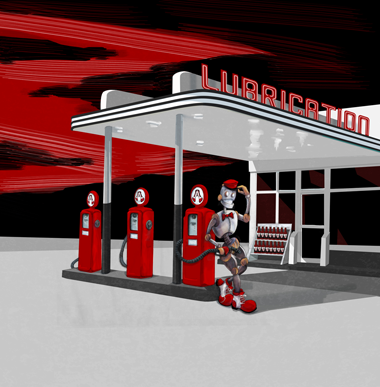
Finally, and this one made me guffaw, I mean seriously spit take—Clown Shoes Lubrication. Why is Lubrication offensive? Well, first, we’ve got the name. It’s tongue-in-cheek, it’s having some fun, but the label copy pulls it all together, “Lube? Hey, get your mind out of the gutter. Social lubrication, people coming together to unwind, is what we’re talking about.” This is not a dirty joke for the sake of being dirty. Lubrication is an American Black Ale, dark as oil, but at only 6% ABV it’s one of Clown Shoes’ first sessionable beers. The social lubrication marketing gives you an idea what you’re getting in the bottle.
Lubrication illustration
Clown Shoes Lubrication, Full Illustration
Second, the illustration is apparently offensive because of the placement of the gas nozzle. Next time you fill your tank, take note of how high you hold the nozzle, I’m guessing it’s not up by your belly button unless you drive a Hummer. Apparently, our critics saw not a dispenser of fuel, but a “dong.” Yes, their words, not mine. I went to art school. I was taught to say, “phallic symbol.”
Now, let me tell you, when I designed this I was inspired by Ed Ruscha’s gas station paintings, 1950′s sci-fi robots, and by those old Texaco commercials with the jaunty hats and ties. That’s it. You get your car lubed at the service station and a tin-man requires lubrication, it works both ways. The client actually wanted to go sans-illustration for this beer, but I convinced him that it would be inconsistent with the brand and that I had a great idea! Never in my wildest imagination did I think this label would inspire such vitriol! But when you have dong on the brain, you see dong wherever you go, I guess. Ironically, robots don’t even have sex that way, there’s a lot more welding and screaming of 0s and 1s.*
So, there you go. If you find your way to my website because I illustrated some beer labels that started a tiny tempest, you will see that I put a lot of thought and research into offending people and selling beer. I also design yearbooks for elementary schools and websites for stores your mom would probably like. I appreciate this opportunity to respond to my critics and I encourage you all to drink good beer with a sense of humor and an open mind.

Sunday, July 3, 2011

Detour Double India Pale Ale

COMMERCIAL DESCRIPTION
Detour blazes the trail for fresh and bold Double IPAs. Four varieties of hops combine to step up the flavor profile. A hoppy adventure that finishes dry. Big in alcohol and character. Venture to pair with other spirited flavors such as those found in spicy ethnic foods.

This sweet baby needs to be loved all the way to the last drop. It will change the way you think about Unita, and I will definitely pick up the rest of the Crooked series. It starts with a big kiss of grapefruit followed by pine in smell. First sip reveals a bold resinous pine and bitterness. Medium mouth feel with bold carb. Alcohol is well hidden and drinks very quickly.  If you get the opportunity to take this seraph home, don’t stutter! And for god’s sake, take your time with her.

Friday, July 1, 2011

Mikkeller Funky (e)★ [fung’ke e’st r] (Funky Easter)

Mikkeller Funky (e)★ [fung’ke e’st r] (Funky Easter)
Mikkeller
Brewed at De Proefbrouwerij
Style: Belgian Strong Ale
Copenhagen V, Denmark
Maybe I just don't get it. Maybe I'm not sophisticated enough. Whatever it is, this beer will never touch my table again. Mikkeller does amazing things; this, imho, is not one of them.
Amber colour with a small head. Aroma is dominated by Bret yeast. Faint hint of hops and apples. Flavour is firstly bret yeast, but after a short while it’s replaced with notes of ashes and nuts as well as some apples. Suprisingly short aftertaste

Hopart by coast brewing

COMMERCIAL DESCRIPTION
Walking a fine line of sweet malt and assertive hop character. A hop presence so enticing it truly is a work of art.

Ingredients: two-row*, Munich* & caramel 20* malts, pacific gems* , centennial & cascades hops, ale yeast and tripled filtered water.                       *organic

Golden orange pour with a sticky head, straightforward c-hop nose. Lots of caramel intensity - even some burnt sugar - in the flavor, with a long resiny hop finish. This one might not be a standout on the West Coast, but it certainly holds its own out here. Drinkability is good, with the 7.7% going all but unnoticed until the buzz kicked in. Nicely done.


Saturday, June 25, 2011

Brickstore anniversary today!

Epic beer list posted on www.beeradvocate.com this is what you can expect at the brickstore pub today.

Per. Brickstore:

The following beers will be on draft when we open at 11am

Allagash Little Big Beer Belgian Strong
Avery 18th Anniversary Dry Hopped Rye Saison
Bell’s The Oracle Imperial IPA
Clown Shoes Eagle Claw Fist Amber Ale
Clown Shoes Hoppy Feet American Black Ale
Creature Comforts Gimme Dat IPA
Birra del Borgo/Dogfish Head My Antonia Imp. Pils
Foothills Gruffmeister Maibock
Foothills Hoppyum IPA
Founders Black Biscuit Old Ale Aged 1yr.
Half Acre Daisy Cutter American Pale
Harviestoun Ola Dubh 40 Yr. Old Ale
Oskar Blues Port Barrel Aged Gordon
Mikkeller Yeast Series-U.S. American Pale
Mikkeller Yeast Series- Belgian Belgian Pale
Mikkeller Yeast Series- Hefe Weizen Hefe weizen
Mother Earth Silent Night Imperial. Stout
Stone 14th Anniversary Emperial IPA
SweetWater Creeper Belgian IPA, 1.5 yrBordeaux Barrel Aged w/ blackberries

When one of the previous beers kick we will hook up one of the following....

Evil Twin Soft Dookie
Stillwater Debutante
Terrapin Hopzilla
08 Great Divide Hibernation
Dogfish Head Bitches Brew
Harviestoun Ola Dubh 18Yr
Rogue Chatoe Orgasmic
Port Older Viscosity

At the top of every hour we will tap the following...
1pm: Coast Red Legs
2pm: J.W. Lees Port barrel aged pin cask
3pm: Firestone Walker Double Jack
4pm: Westbrook IPA
5pm: Olde Hickory Black Ravin IPA
6pm: Ballast Point Sculpin IPA
7pm: J.W. Lees Lagavulin Pin Cask
8pm: Olde Hickory Death by Hops
9pm: Foothills Barrel Aged Total Eclipse


Friday, June 24, 2011

SKA Decadent Imperial IPA

COMMERCIAL DESCRIPTIONLacking nothing, at ten percent alcohol by volume and 95 International Bitterness Units, the Decadent truly represents all that is self indulgent when it comes to drinking beer.

Aroma of hops, fruit, citrus, light caramel malts, and some peach and melon. Poured orange/amber in color with a large, dense, rocky, beige head that lasted throughout. Clear. Not sparkling. Excellent lacing. Flavor is lightly sweet and lightly bitter. Tastes of hops, caramel, malts, fruit, nectar, slight resin, and some pine. Medium body. Lightly sticky, then dry texture. Average carbonation. Sweet, hoppy, caramel finish is lightly dry.
 
ping podcast